Terminology
In pursuit of our mission to promote conservation, facilitate rediscovery, and preserve a record of extinct species, we suggest a system of terminology that is intuitive, easily implemented, and complementary to other approaches used by leading conservation organizations, such as the International Union for the Conservation of Nature (IUCN).
We acknowledge that the study of contemporary extinction is a developing field, and concepts will evolve. Below, we provide a conceptual diagram and working definitions for relevant terms, which authors should use when writing Reports (see Article types).
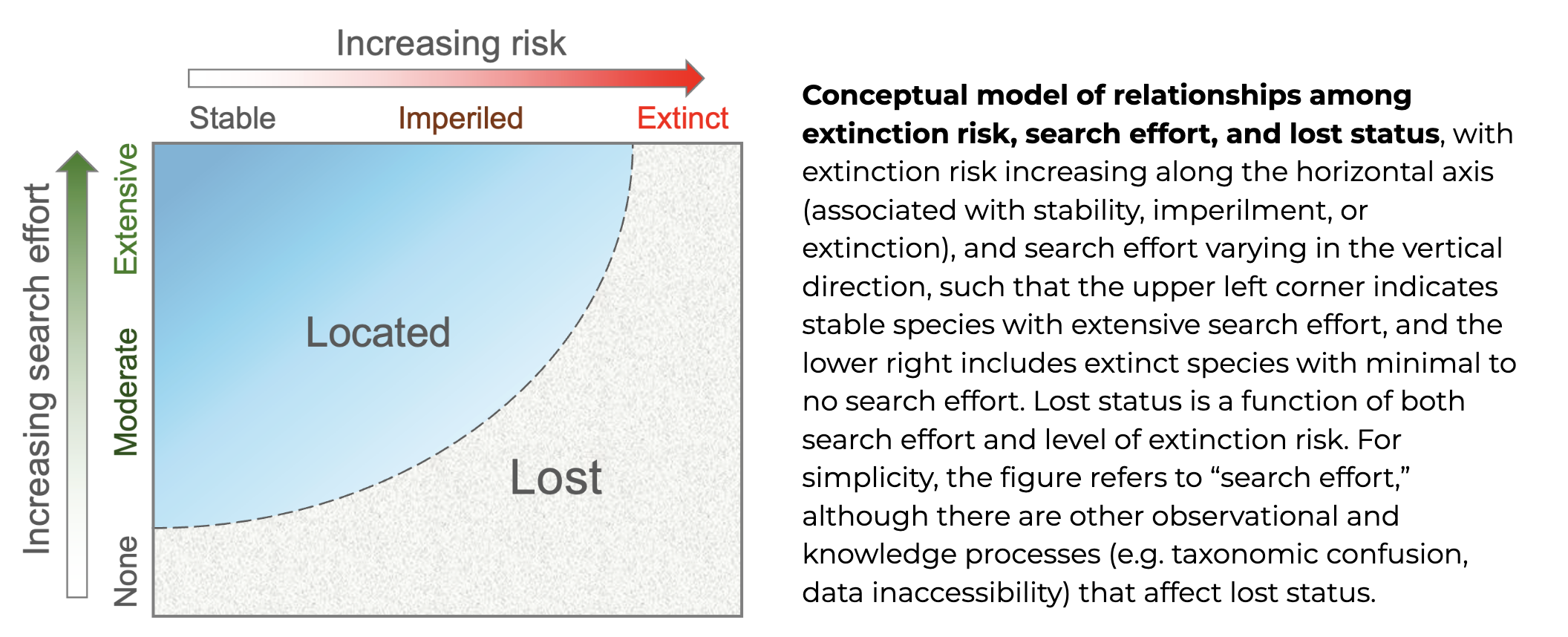
LOST species are those that have not been detected in the wild for at least ten years*. Whereas terms such as stable, imperiled, and extinct are indications of biological status, the designation of lost involves the outcome of both biological and observational processes (see figure above). The status of lost can be associated with rarity and decline, but also with low detection probability, low search effort, or a lack of information. Thus, being lost by itself does not inherently reflect extinction risk, just as the ability to locate a species (i.e., detect it in the wild) does not necessarily imply a specific risk level. Nevertheless, a species that has not been seen in ten years despite intense search effort is likely of greater conservation concern than a species that has been the focus of only minimal search effort. Thus, the designation of lost, when coupled with extensive search effort, has the strongest conservation relevance (see Author Guidelines for reporting requirements on search effort).
* Long, B. and Rodríguez, J.P., 2022. Lost but not forgotten: a new nomenclature to support a call to rediscover and conserve lost species. Oryx, 56(4), pp.481-482.
STABLE implies that a species does not, at present, appear to be of conservation concern. A species with this status might be designated as Least Concern in an IUCN extinction risk assessment.
IMPERILED indicates a species is at an elevated risk of extinction, which might be indicated by phenomena that include, for example, extirpations (loss of local populations), range contraction, increasing rarity throughout the range, over-harvesting, or loss of key resources for particular life history stages (e.g., through habitat destruction on overwintering grounds). Imperiled is an intentionally flexible and broad category, and can be used to motivate conservation, additional search effort, and other actions. Different systems (e.g., the IUCN Red List) include gradations of risk or imperilment, and we encourage authors to use the vocabulary from other sources as needed within the framework suggested here.
EXTINCT refers to species for which we can say with considerable confidence that they are gone, in the wild and in captivity (i.e., no living individuals remain). In the words of the IUCN, a species is extinct if there is no reasonable doubt that the last individual has died, which should be verified with extensive search effort by experts. In most cases, many decades are needed to be confident that a species is extinct, although a shorter timeline is possible, for example in cases of range-wide habitat destruction. In all cases, we encourage authors to use caution when declaring extinction, and such declarations will be treated in JLS publications as scientific hypotheses in need of further evaluation and open to falsification.
Note that the definitions above refer to species, but equally apply to subspecies, varieties, and other taxonomic units, and may be used for undescribed species with sufficient documentation (see Article types). Moreover, the species-specific details of biology, detectability, and other issues mean that the definitions and framework outlined here will need to be considered carefully by authors so that implementation in any particular case is effective and accurate.